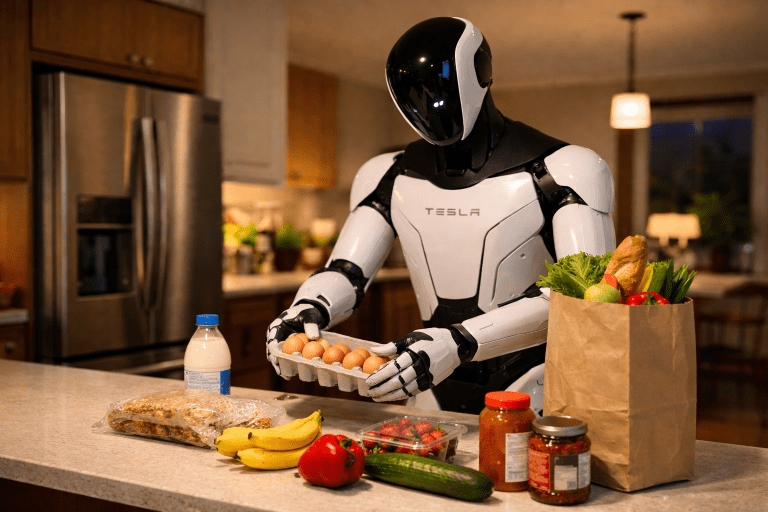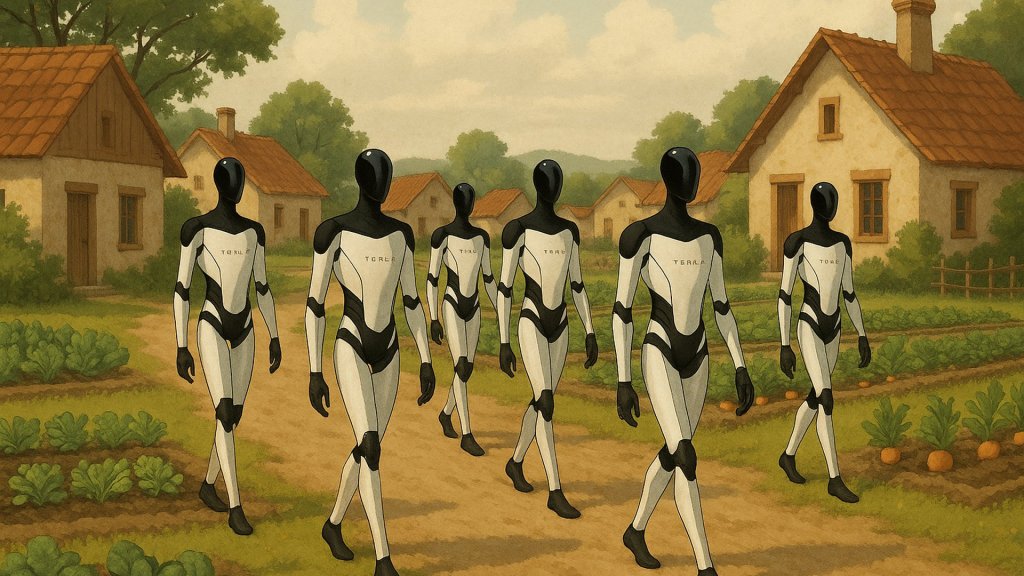
Elon Musk has intensified his argument that artificial intelligence may push society toward a post-labour economy in which traditional employment becomes optional and individuals might “choose to grow vegetables in a village” while robots perform most economically essential work. The idea, he says, reflects the emergence of what he describes as a robotic proletariat—a machine workforce capable of producing abundance without human input.
Musk frames the shift as a consequence of rapidly advancing general-purpose robotics and increasingly autonomous AI systems. In his view, these technologies could become so productive over the next 10 to 20 years that governments may introduce Universal High Income (UHI), a form of social support that guarantees financial stability regardless of employment status. Under that model, work becomes a lifestyle choice rather than an economic necessity.
He argues that in an AI-driven economy, many people may explore slower, self-directed ways of living—rural communities, craftsmanship, small-scale agriculture or creative work—while machines handle most industrial, commercial and service workloads. Musk also notes that the concept challenges conventional economic thinking, as the traditional connection between labour and livelihood weakens.
However, he has also warned that the journey to such a system would be “deeply disruptive,” pointing to the potential for job displacement, income shocks and psychological strain as AI reshapes productivity and employment patterns.
Evidence Already Points to Structural Shifts
Although Musk’s post-work vision remains speculative, measurable pressure on specific job categories is already visible. U.S. modelling from 2025 suggests that current-generation AI tools could replace roughly 12% of the national workforce—equivalent to more than US$1 trillion in annual wages. The categories most exposed share a common pattern: repetitive, predictable, rules-based work.
Clerical jobs, data processing roles, junior accounting functions and routine administrative support tasks top the list of vulnerable occupations. These functions map closely to AI’s strengths—processing structured data, generating standardised documents, answering predictable queries and automating workflows.
Companies across Australia, the U.S. and Europe report similar trends. Surveys indicate that around 40% of firms are already reconsidering hiring plans due to AI capability, and several large enterprises have announced workforce reductions citing automation as a key factor. Customer support centres, back-office processing hubs, routine financial operations and entry-level “knowledge worker” roles are among the first to be restructured.
Conversely, demand is rising in areas where AI falls short—judgment, relationship management, complex problem-solving, creativity and human-sensitive decision-making. These skills increasingly define the labour categories described as “AI-complementary.”
A Work-Optional Future Faces Major Unknowns
Despite the pressure on routine work, economists emphasise that the overall labour market has not collapsed. Aggregate job data remains relatively steady, and AI adoption is uneven. As of 2025, fewer than one in ten companies globally deploy AI extensively across operations. Even when tasks are automated, many roles evolve rather than disappear.
Analysts warn that Musk’s “robot proletariat” scenario hinges not on technology alone but on policy design, regulatory reform, and the political willingness to build new social safety systems such as UHI. Without such support, the transition could widen inequality and concentrate economic gains among a small number of technology-rich firms.
The next decade will determine whether the world shifts toward broad automation with social stability, a hybrid human–AI workforce, or a more fragmented labour market. For now, what is clear is that routine and repetitive roles are already under strain—and the conversation Musk has sparked about a society where work is optional is rapidly moving from theory to mainstream economic debate.