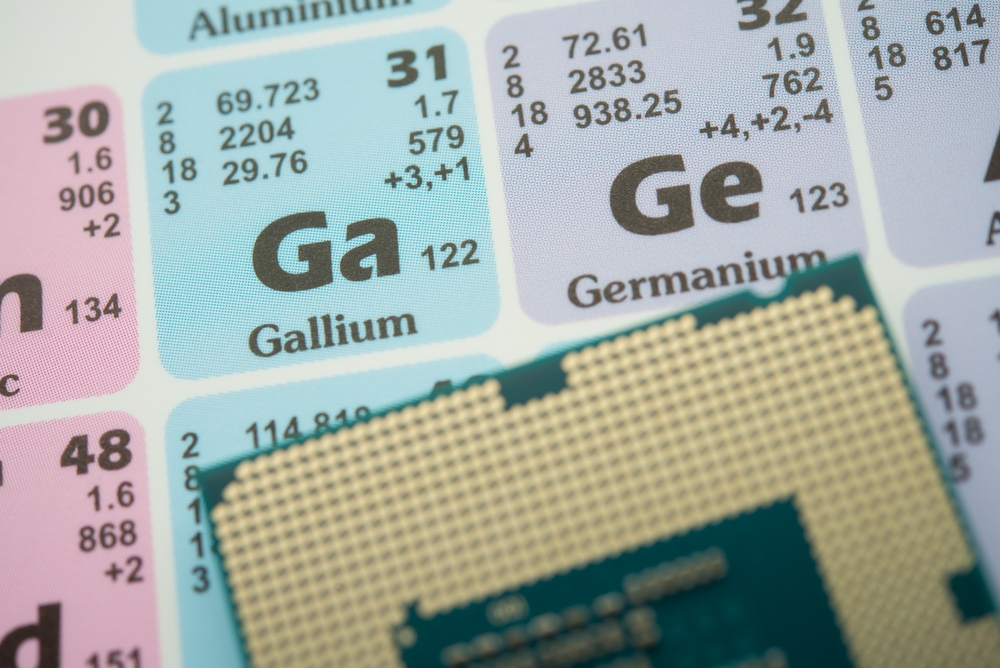
Gallium (element Ga) isn’t a name most retail investors recognize. But this soft, silvery metal is quietly becoming essential in some of the world’s fastest-growing tech sectors — especially artificial intelligence, defence, and clean energy. For investors eyeing early-stage ASX-listed explorers, understanding Gallium’s strategic role and market dynamics could be key to capturing upside before the crowd arrives.
What Is Gallium?
It is a post-transition metal with a low melting point — turning into liquid just above room temperature. Unlike base or precious metals, gallium isn’t traditionally mined directly. Instead, it’s usually extracted as a by-product from processing bauxite (aluminium ore) or zinc. Although, this may change as you’ll realise below.
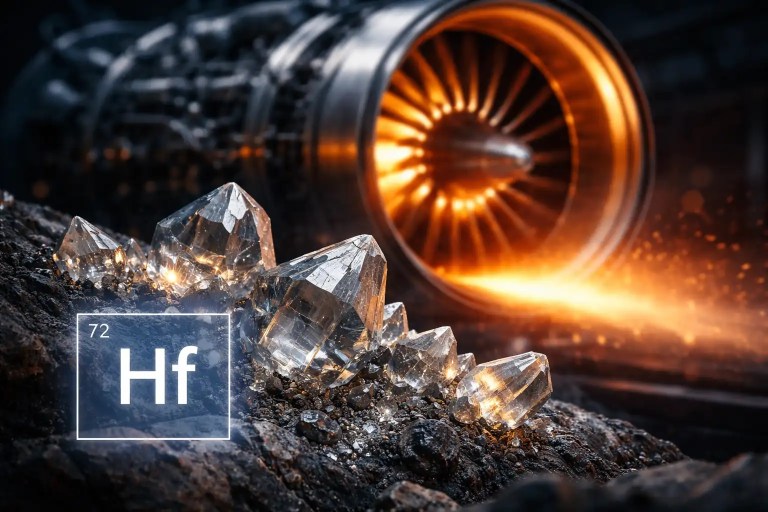
Its key properties — high thermal stability, low vapor pressure, and excellent electronic characteristics — make it indispensable in high-performance semiconductors.
What is it Used for?
Gallium use 1: Semiconductors and 5G
The bulk of gallium today is used in compound semiconductors like gallium arsenide (GaAs) and gallium nitride (GaN). These are essential for 5G base stations, smartphones, satellite communications, and defense radar systems. Compared to silicon, Ga compounds handle higher frequencies and operate at higher temperatures.
Gallium use 2: AI and Data Centers
The AI boom is creating rising demand for gallium nitride chips, which offer faster processing and better energy efficiency. Major tech firms like Nvidia and AMD are turning to GaN for next-gen GPUs and data center applications.
Gallium use 3: Solar and Green Energy
Gallium is used in high-efficiency solar panels, particularly gallium-indium-phosphide solar cells deployed in space. As satellite and aerospace demand climbs, so too will this use of this critical metal.
Gallium use 4: LEDs and Consumer Tech
GaAs and GaN are key in producing LEDs, laser diodes, and high-end display technology. The shift to electric vehicles also uses Ga in power electronics.
Gallium use 5: Defense Applications
GaN-based radar and electronic warfare systems are increasingly standard in modern militaries. The U.S., China, and EU are securing supply lines exactly for this reason.
A Supply Chain with Red Flags
China dominates Gallium production. Over 95% of refined gallium comes from Chinese smelters. It’s not because China holds more raw materials — rather, it’s due to its dominance in aluminium refining and its willingness to supply gallium cheaply.
That changed in 2023. Beijing imposed export restrictions on gallium and germanium, both deemed critical to national security. Prices spiked and policymakers in the West took note. The U.S., EU, and allies, including Australia, began looking for alternative supplies.
Gallium Price and Market Size
The gallium price is volatile and opaque due to the niche market and lack of direct mining. In 2022, gallium metal traded around US$300/kg. During the 2023 export curbs, prices briefly surged past US$700/kg, before falling to about US$450/kg in early 2025.
Market size remains small but strategic. The global gallium market was estimated at US$400–500 million in 2024, with under 500 tonnes of annual production. But industry forecasts suggest the market could exceed US$1.5 billion by 2030, driven by AI chips, GaN power electronics, and aerospace applications.
That’s more than 3x growth — a sharp trajectory for a critical input.
Where Australia Fits In?
Australia does not currently produce gallium, but it hosts significant bauxite and zinc operations — both of which can yield Ga as a by-product. Several ASX-listed explorers and developers are beginning to assess this opportunity. Key ASX players exploring gallium mining or recycling potential include (not ranked):
1. Alpha HPA (ASX: A4N):
Focused on high-purity alumina from kaolin feedstock, Alpha HPA’s process yields Ga as a by-product. Their Gladstone facility could become a domestic gallium source by 2026.
2. Altech Batteries (ASX: ATC):
Altech is developing high-purity alumina from kaolin in WA. While its main focus is battery materials, Ga by-product recovery has been flagged in investor updates.
3. DY6 Metals (ASX: DY6):
DY6 is an emerging gallium play following a review of historical drill results at its Tundulu Project in Malawi. Drilling revealed high-grade Ga mineralisation, including 74m at 93.26g/t Ga₂O₃ and 14m at 202.79g/t Ga₂O₃. Mineralisation starting from surface in some zones. High-Grade Gallium Discovery Boosts DY6 Tundulu Project – Stock Surge
4. Impact Minerals (ASX: IPT):
Impact’s Broken Hill project includes rare earths and potential gallium-enriched zones. The company is undertaking further sampling to evaluate economic viability.
5. Group 6 Metals (ASX: G6M):
Though primarily a tungsten producer, its tailings and waste streams are under assessment for minor elements including gallium and indium.
6. Battery Age Minerals (ASX: BM8):
BM8 is progressing its Bleiberg project in Austria, where Ga grades between 90–110ppm have been identified. While the company’s core focus is germanium — gallium recovery is under exploration.
7. Golden Deeps (ASX: GED):
Known for vanadium and base metals, GED is investigating gallium extraction from its Namibian operations. With access to polymetallic deposits, the company is assessing whether Ga can be efficiently recovered as a by-product.
Gallium Recyclers
8. MTM Critical Minerals (ASX: MTM):
MTM is undertaking “urban mining” to recover gallium and other critical minerals from tech waste. Its feasibility study into e-waste recycling is part of a broader push toward circular supply chains. In February 2025, the company said that it had achieved successful recovery of gallium & germanium from semiconductor industry waste using its proprietary flash joule heating technology at its lab in Houston, Texas USA.
9. Bayan Mining and Minerals (ASX: BMM):
Bayan has secured tech from Macquarie University for “Microwave Joule Heating Technology” a microwave-based solar panel recycling technology. The company intends to commence further research and development to assess the ability to potentially recover valuable metals such as Silver, Silicon, Gallium and Indium from expired solar panels.
Critical Minerals Status Brings Tailwinds
Gallium is now classed as a critical mineral by multiple governments — including Australia, the U.S., Japan, and the EU. This brings investor-friendly policies such as:
- Federal funding and grants for critical mineral projects
- Export credit support from Australian institutions
- FIRB priority reviews for strategic partners or buyers
- Priority infrastructure development in key mining regions.
For ASX hopefuls, this creates a favourable environment to scale exploration, attract offtake partners, and build processing capacity domestically.
Investment Considerations
1. Gallium is not a primary revenue driver — yet: Most ASX players view the metal as a future by-product. Investors need to scrutinize the economics: what volumes can be recovered? At what purity and cost?
2. Processing is complex: Extraction requires advanced chemical separation. Projects that already have hydrometallurgical infrastructure (like HPA or alumina refineries) may be better positioned.
3. ESG and strategic value: It’s role in decarbonization and defence technology gives it strategic ESG value. Investors should factor this into long-term positioning.
4. Demand is real, but concentrated: A few sectors — notably AI chips and defence — drive most demand. This can magnify both upside and downside, depending on tech and geopolitical shifts.
Analyst Forecasts and Market Trends
S&P Global expects gallium demand to double by 2030, with a compound annual growth rate (CAGR) of 12–15%. The fastest-growing segment? GaN semiconductors, projected to rise from US$1.3 billion in 2024 to US$5 billion by 2030.
Meanwhile, Chinese dominance is likely to decrease as new capacity comes online in North America, Europe, and possibly Australia.
If Australia can establish even a 50-tonne annual stream, it would place the country among the top five non-Chinese suppliers globally — a strategic and economic win.
Recycling: An Emerging Gallium Source
Recycling electronic waste is becoming an important secondary source of gallium. As gallium is widely used in LEDs, semiconductors, and solar cells, tech waste contains recoverable quantities — especially from discarded smartphones, servers, and flat-panel displays.
MTM Critical Metals (MTM ASX) is advanced in exploring this angle. The company recently announced a feasibility study into urban mining, targeting recovery of rare earths and specialty metals like Ga from e-waste and industrial scrap. MTM’s strategy taps into a growing push for circular supply chains and could complement primary production from mining or refining. In April, MTM secured a supply agreement for with leading U.S.-based recycling firm Dynamic Lifcycle Innovations. The agreement clears a path for supply of at least 700 tonnes per annum of E-waste supply for its pilot plant under development.
Bottom Line for Investors
Gallium isn’t a household name — but that’s precisely why it may offer outsized returns. As AI, defense, and clean energy drive exponential demand, gallium’s strategic importance is only just beginning to hit investor radar.
ASX-listed companies able to recover Ga as a by-product from alumina (aluminium gallium) or kaolin may find themselves well-positioned. But investors must do the homework — focus on recovery economics, processing pathways, and strategic partnerships.
In a world reshaped by semiconductors and critical minerals, Ga is a small metal with outsized influence. For those willing to bet early, it may be one of the ASX’s more underappreciated growth stories.