European Metals (ASX: EMH & OTC: EMHLF) has completed a Definitive Feasibility Study outlining the scale, economics and execution plan for the Cinovec lithium project in the Czech Republic. The study positions Cinovec as a long-life, vertically integrated producer of battery-grade lithium carbonate, located inside Europe’s core electric-vehicle and energy-storage manufacturing zone.
The DFS confirms steady-state production of 37,500 tonnes per annum of battery-grade lithium carbonate. That output equates to roughly 5.2% of forecast European Union demand by 2030. The project is designed to operate for more than 26 years, supported by one of the largest hard-rock lithium resources in Europe.
Scale and operating life anchored by defined reserves
Cinovec is underpinned by a JORC-compliant resource of 747.5 million tonnes grading 0.19% lithium. The defined reserve supports over 22 years of production within a 27-year mine plan. Annual ore throughput is scheduled at approximately 3.2 million tonnes once full production is reached.
The mine plan is based on large-scale underground extraction using sub-level open stoping. This approach benefits from favourable rock conditions and historical mining data, which reduces uncertainty in mine design and scheduling. Paste-fill is incorporated to maximise extraction and stabilise underground workings.
Integrated processing inside an established industrial region
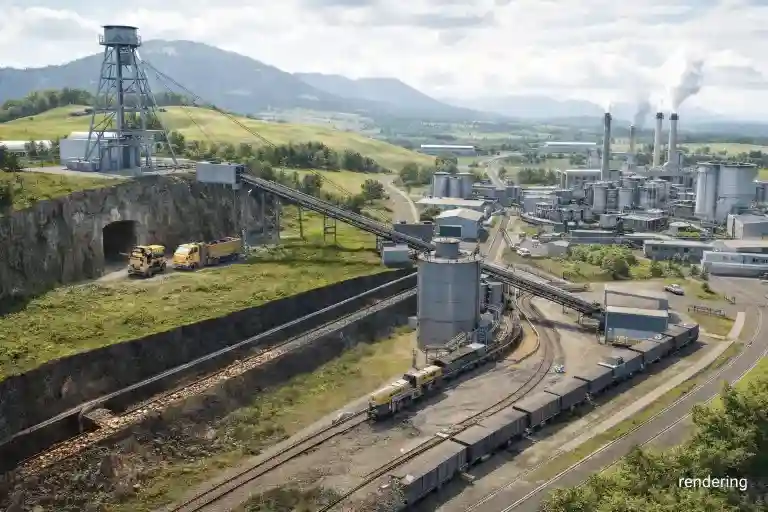
The DFS outlines a fully integrated operation, spanning underground mining, beneficiation, chemical conversion and final lithium carbonate production. Ore will be crushed underground and transported via a 7.3-kilometre aerial conveyor to a central transfer hub. From there, material moves by rail to the Prunéřov processing complex.
This logistics design eliminates long-distance trucking, reduces emissions and lowers operating risk. Rail transport also provides year-round reliability and leverages existing Czech infrastructure. Tailings are returned underground as paste-fill, further limiting surface disturbance.
Battery-grade product confirmed through pilot work
Extensive metallurgical testing supports production of lithium carbonate meeting international battery-grade specifications. The flowsheet uses flotation to concentrate zinnwaldite, followed by roasting, leaching and purification in the lithium chemical plant.
Testwork demonstrates lithium recoveries of more than 80% into final lithium carbonate. Concentrate grades and recoveries remain consistent across varying head grades. This consistency underpins confidence in long-term operating performance.
Economics shaped by scale and government support
Using a flat lithium carbonate price of US$26,000 per tonne, the DFS estimates a pre-tax net present value of US$1.46 billion at an 8% discount rate. Pre-tax internal rate of return is calculated at 14.8%. Life-of-mine all-in sustaining costs are estimated at US$13,879 per tonne.
Initial capital expenditure totals US$2.16 billion, including contingency. Approved government grants reduce net initial capital to approximately US$1.72 billion. Sustaining capital across the mine life is estimated at US$498 million.
Strategic location strengthens offtake positioning
Cinovec sits within 200 to 350 kilometres of multiple operating and planned European gigafactories. More than 20 automotive manufacturing plants operate within a 400-kilometre radius of Prague. This proximity lowers logistics costs and shortens supply chains for battery and vehicle manufacturers.
The DFS confirms that discussions with European battery producers, cathode manufacturers and automotive groups are at an advanced stage. Final DFS parameters allow these discussions to move toward binding offtake agreements.
Funding pathway now defined
The project benefits from significant state backing, including approval for up to €360 million in Czech government grants and support from the EU Just Transition Fund. European Metals is progressing discussions with European banks, export credit agencies and strategic partners to structure project-level funding.
With the DFS complete, the focus shifts to financing, permitting and final investment decision preparation. Early works, front-end engineering and environmental approvals are scheduled to advance through 2026.